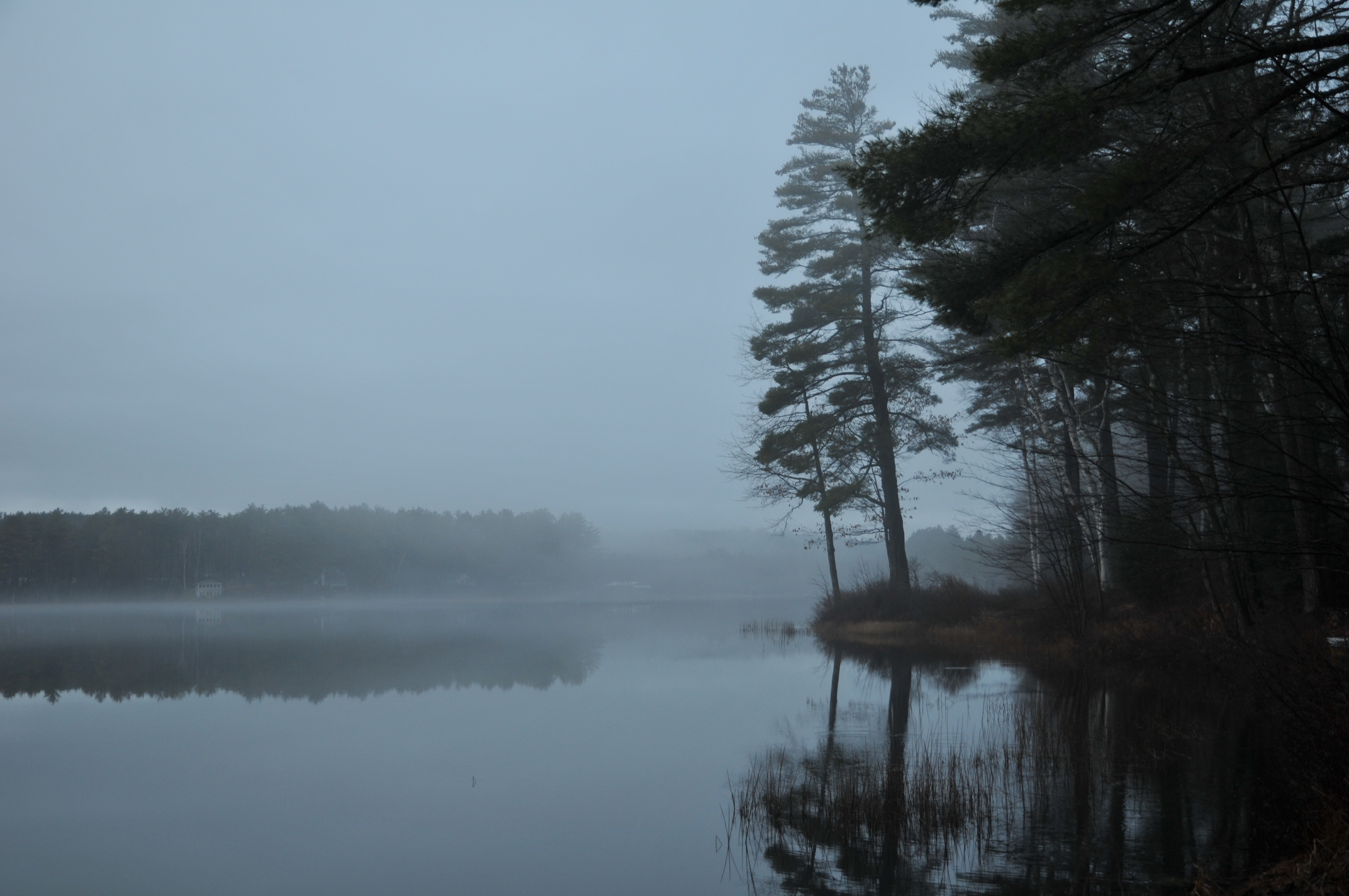
Section 2.1 The year 1968
Subsection 2.1.1 Assessing interest
On June 24, 1968, Joan and Warren Heinzelmann [property 236-028] sent a letter of inquiry asking current Stocker Pond property owners if they were interested in forming a Stocker Pond Association to create a collective voice for matters related to the Pond. On July 6, an informal meeting with Mr. and Mrs. Glenn Haskell [property Southeast side of pond], Mr. Don Cole [property 236-026], and Joan and Warren Heinzelmann [property 236-028] gathered to discuss the replies and begin work on drafting by-laws for the Association. They set the date of August 17 "for the purpose of discussing and preparing a first draft of our by-laws, and possible selection of interim officers."
Almost immediately, some issues which the Association might want to consider were brought to the attention of the organizers: over development of shoreline property, power boats on the Pond, as well as of course the damage done in the spring run off from the interstate construction. These and other issues became recurrent themes throughout the history of the Association; some of them generated significant acrimony.
Subsection 2.1.2 The first meeting
The first organizational meeting was held on August 17. The minutes 🔒 included a list of 17 property owners who were interested in the formation of an Association.
Excerpting from the minutes, there were a number of actions which were initiated.
-
Election of Officers included President and Director Warren Heinzelmann [property 236-028], Secretary-Treasurer and Director Theodore Rouillard [Lumber Lane], and additional directors Donald Cole [property 236-026], Joseph Dasaro [property middle, west side], and John Heinlein [property 236-203].
-
Direct Secretary-Treasurer Rouillard to write on behalf of the Association to Commissioner John O. Morton of the New Hampshire Public Works Department and Mr. John Palazzi of the Palazzi Construction Company to request a meeting the week of August 26 for the purpose of infoming the property owners on the current status of the water pollution situation.
-
Direct President Heinzelmann to draft of Association by-laws modeled on those for Crescent lake in Ackworth, NH.
-
Set the date of October 19 to approve by-laws and to apply for incorporation with the State of New Hampshire.
Subsection 2.1.3 The meeting with Officials
Answering a request for information on the correctional procedures, if any, being taken to decontaminate the waters of Stocker Pond, which has had a heavy silt suspension throughout the year due to run-off from the road construction project east and northeast of the pond, the State of New Hampshire Department of Public Works and Highways sent the following representatives to the August 29 meeting of the Cottage and Property Owners Association of Stocker Pond at the Cottage of Mr and Mrs. Warren Heinzelmann: Hon. Robert H Whitaker, Deputy Commissioner; Frederick Hanson, State Area Construction Engineer; Gale Watson, State Resident Engineer on the Palazzi project; and William Rice, State Resident supervisor on the Payne and Caledonia projects. Also honoring the Association’s request for his presence was John Palazzi, head of the Palazzi Construction company.
Main points include:
-
Deputy Commissioner Whitaker said that “from a similar experience of several years ago, we don’t have too much doubt that when the pond freezes over and the wave action stops, that this condition will clear up.” He said that this similar situation had occurred in Sundoggedy Pond in Northfield, and that the State had been terribly concerned. The State, he said, called in world-renowned experts on soil, to analyze the problem with a view to correction. The soil experts, he said, advanced the theory that when the wave motion stopped the waters of Sundoggedy would clear. This, he continued, did occur following the winter freeze and accompanying cessation of wave motion.
-
To the question as to what will happen in the spring, Mr. Palazzi prefaced his answer with the statement that he was terribly embarrassed over the situation. "I’m chairman of the Water Pollution Board and I want to tell you that we did everything we could do when we heard about it." He said that his engineers watched Baptist and Otter ponds, "where we thought we would have most of the problem, if any. We discovered Stocker Pond coloring, and we set up brook bars to try to stop it but to no avail. Then the next thing to do was to do the job as fast as possible—get the grass growing, and it is growing. The State has been on our tails right along."Mr. Palazzi said that “we are trying to get ditches lined with stone to prevent washing. This is no small project,” he explained, “it took two million yards of fill in back of our camp. The worse bank is back of our yard south of Stocker. The big problem is there. We are sure come next spring that the pond will be cleared. Come next spring, if it isn’t cleared, I don’t know what we can do: perhaps we may have to treat the water.”
-
To Mr. Rouillard’s question as to what could be expected from the wave motion and wash in the spring in the east cove section where silt and sand had piled up to a depth of from two to two and and half feet over an area approximately 20 by 30 feet, both on land and in the water, Mr. Palazzi said that "Payne’s project is responsible there.""Mr. Rice, the state’s resident supervisor on the Payne project said that Mr. Rouillard’s appraisal of the cove situation was fair. He said that he would take this matter up with Payne Construction.
-
Several other issues were touched upon. Broad fluctuation of water levels in the pond had been experienced with low levels causing some navigation problems, while higher levels causing beaches on the west side properties to disappear. There was discussion of a dam or cross boards against the culverts at the north end, though in the end it was pointed out that it was the Water Resources Board which controlled the level of the water in the Pond. Fluctuations of the water level had many causes. Beavers at the north end had caused periodic rises in water levels. It was also pointed out that water flows into the pond were complex with the normal flow entering from the Sanborn Hill side and exiting to the north, but in times of heavy rains or spring melt, water often flowed south through the culverts at the north end.
Subsection 2.1.4 The issue of an outlet dam
Establishing a consistent level of water in Stocker Pond has been an issue since people first built camps on the west side. In the early years the water level was quite low, exposing extensive sandy beaches on the western shore. Periodically, beaver dams would raise the level of the pond not only covering the beaches, but in one case putting the property marker under water. Low water levels were occasionally problematic for those owners of power boats and in the early days, boat houses. This tension continued, and the State was asked to consider construction of a dam at the north end to regulate the level.
On September 23, 1968, Robert Whitaker Deputy Commissioner and Chief Engineer for the Department of Public Works and Highways wrote to Theodore Rouillard who had been spearheading this effort with a definitive "no". After a review of the situation by various engineers from the State, the conclusion was:
Eastman Brook and Stocker Brook act as a natural control for maintaining the water level in Stocker Pond. The water in Stocker Pond is replenished by reversal of flow in the Stocker Pond outlet. Any man-made device for maintaining the water level above the normal level in Stocker Pond should be automatic or maintained frequently by capable personnel.It is recommended that no further study be made to construct a control for Stocker Pond and that any plans for constructing a control be abandoned.
Of course this was only the start of conversations about water level and beavers. It was brought up in the October meeting, that the flood control structure on Eastman Pond will also improve water flow into Stocker Pond.
In the recent past, perhaps 2018 or 2019, the dam at Palazzi Pond broke in a torrential rain in January which drained that pond and raised the sheet of ice covering the Stocker Pond by approximately four feet! Eventually the water level subsided and as it was winter, no real damage was done. In the early 2020’s, the water level had again risen at least a foot due to the army of beavers north of the Pond. This has increased erosion of shoreline, but perhaps not surprisingly improved water quality somewhat.
Subsection 2.1.5 Land for cemetery expansion
It seems that in September of 1968, the Town contacted Joseph Dasaro to buy his waterfront property to expand Hilldale cemetery. He said that the Town had threatened to take possession by eminent domain. Mr. Dasaro engaged a law firm in Hanover. Quoting from the letter from from Hanover attorneys to N. George Papademas of Lebanon, NH:
Without knowing all the facts, it seems to me quite unusual for a town to condemn land for a cemetery which borders on a lake. All of us who have been practicing law in New Hampshire in recent years have recognized the skyrocketing values of lake shore property and it would seem sensible to allow this land to be developed for recreational purposes rather than used as a cemetery.
On November 4, Warren Heinzelmann as President of the Stocker Pond Association, wrote to N.George Papademas, saying that the membership of the Association strongly objects to such action." He goes on to write that "Mr. Dasaro has assured us that he will contest this action and the membership is unanimous in its support."
Subsection 2.1.6 Stocker Lake vs Stocker Pond
At the Stocker Pond Association meeting of October 19, plans went forward to refine the articles of incorporation, and agreed that attorney fees would be shared equally among Association members. The Association members also wanted the attorney to look into the possibility of changing the name of Stocker Pond to Stocker Lake.

